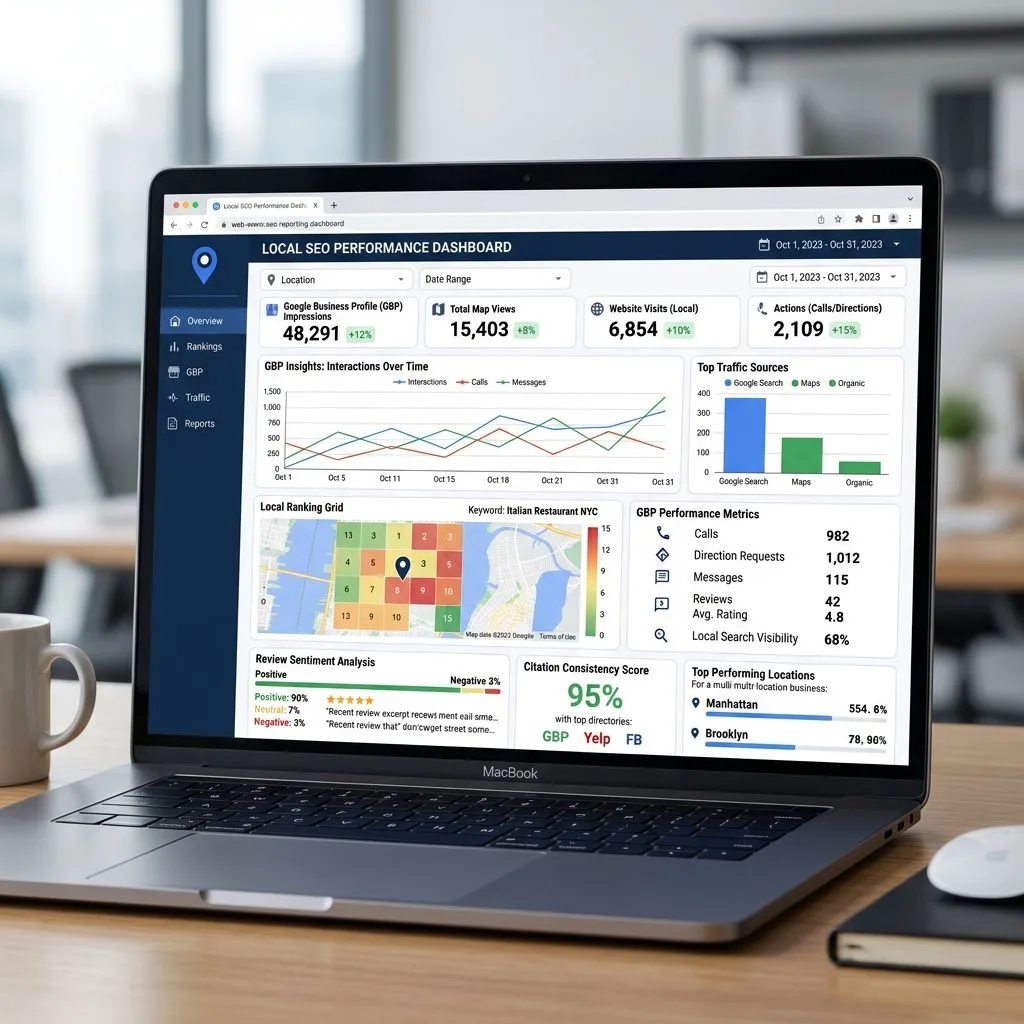
White label SEO reporting has to do more than place an agency logo above a chart. It should show what changed in search visibility, which pages or queries drove the movement, and whether that movement supports useful business outcomes. I treat the report as an explanation layer between raw platform data and a client decision. That means separating evidence into clear groups, preserving historical context, and showing rankings alongside clicks, visits, leads, or conversions. A current-period ranking snapshot alone cannot explain campaign performance.
Google Search Console provides the search-facing detail: queries, impressions, clicks, click-through rate, and landing-page performance. Google Analytics 4 adds traffic sources, landing pages, user interactions, and conversions. I use both when the reporting setup supports them, because visibility data and site behavior answer different questions. Accuranker describes this combination as a foundation for useful reporting.
The report should organize metrics by the decision they support, not present an undifferentiated list. I normally separate search visibility, traffic, engagement, business outcomes, technical health, and authority. The exact fields can vary by client, but each selected metric should have a clear interpretation and a reason for being there.
Rankings are useful evidence, but they are not the conclusion. I connect a ranking change to clicks, organic visits, conversions, or another relevant outcome before describing it as progress. I also retain historical comparisons and annotate meaningful external events, since a single current-period snapshot can hide the direction of performance. WhiteLabelSEO.ai recommends treating rankings as supporting evidence while connecting them to measurable results. For related coverage, see How to Choose an SEO Company in NEPA.

Core report data and metrics
A useful white-label SEO report combines search visibility, traffic, engagement, business outcomes, technical health, and authority. I start with Google Search Console for queries, impressions, clicks, click-through rate, and landing-page performance, then use Google Analytics 4 alongside it for traffic sources, landing pages, user interactions, and conversions. Accuranker identifies these as core reporting inputs.
Rankings belong in the report, but they are supporting evidence rather than the result itself. I connect ranking movement with clicks, organic visits, leads, conversions, or revenue trends, following the outcome-focused approach described by WhiteLabelSEO.ai. The same view can include organic conversions, bounce rate, branded and non-branded traffic, backlink gains and losses, page speed, and crawl issues when the connected data sources support them. Historical visibility and trend context matter as well; a current-period snapshot cannot show whether a change is temporary, sustained, or part of a longer movement.
| Metric group | Examples | Reporting purpose |
|---|---|---|
| Search visibility | Keyword rankings, impressions, CTR | Shows reach and search visibility over time |
| Organic traffic | Organic visits, landing pages, channels | Shows visits generated through search and where they arrive |
| Business outcomes | Conversions, leads, revenue trends | Connects SEO activity to measurable business results |
| Technical health | Page speed, crawl issues | Identifies barriers to search performance |
| Authority | Backlink gains and losses | Tracks changes in site credibility signals |
I keep engagement measures such as user interactions and bounce rate close to the traffic data, while conversions and revenue trends sit with the business results. That structure prevents a report from becoming an undifferentiated list of figures. For example, a ranking increase becomes meaningful when the related landing page also gains clicks, organic visits, and conversions; a crawl issue matters because it may restrict how search engines access that page. A report showing that chain gives the reader a concrete connection between visibility and business impact.
Client-friendly report structure
A client-friendly report starts with a short executive summary, not a wall of charts. I state what progressed, what blocked progress, and what should happen next in plain language so the client understands the month before reviewing the detail. A useful structure then moves from results to interpretation, priority issues or opportunities, recommended actions, and objectives for the next reporting period. That repeatable order gives every report a clear job and makes changes easier to discuss. Accuranker supports this sequence, while WhiteLabelSEO.ai emphasizes an outcome-focused summary. For related coverage, see SEO – rankspan.zenzen1.com.
- Start with the result. Summarize the reporting period’s meaningful movement, then identify the areas that need attention. Keep the language tied to the client’s goals rather than opening with definitions or unexplained abbreviations.
- Interpret the movement. Explain what changed, where it changed, and why it matters. For example, connect Search Console clicks, impressions, click-through rate, queries, and landing pages with the campaign activity that affected them. A rise in impressions without a corresponding improvement in clicks calls for a different response than broader gains across relevant pages. Accuranker describes this connection between performance data and campaign context.
- Rank the opportunities and problems. Each priority should identify the likely consequence and the action that addresses it. A weak page may call for content optimization, a crawl barrier for technical remediation, and a traffic increase without leads for follow-up conversion analysis. Google for Developers recommends connecting SEO work with measurable objectives and outcomes.
- Turn each KPI into a decision. Do not leave a chart to explain itself. Pair the metric with a short interpretation and a next action, such as reviewing a landing page, expanding a query theme, or checking a conversion path. This keeps the report useful for a client who does not work with search data every day. WhiteLabelSEO.ai recommends this interpretation-action pairing.
- Close with the next period’s objectives and add annotations where outside events clarify the movement. A known Google update or another material event can explain a sudden change in clicks, impressions, or rankings. Keep charts simple, define unfamiliar terms at first use, and remove metrics that do not support the client’s stated goals.
The practical test is whether a client can move from a reported change to a reasonable decision without decoding raw charts. For instance, a landing page with more impressions but a weaker click-through rate should lead to a focused review of its search appearance and relevance, not another page of disconnected metrics.

Features that support agency workflows
A reporting platform should let an agency control the client-facing experience from the first login to the final report. That can include the agency logo, color palette, branded domain or subdomain, client portal, reusable templates, email notifications, and removal of provider branding where the platform supports it. These controls matter because a report is part of the service experience, not just a container for exported data. MetricNexus describes white-label software in these terms, including branding across portals, templates, and notifications.
The operational test is whether the workflow removes repeated assembly without hiding important judgment. Data collection should connect search, analytics, ranking, backlink, and technical sources instead of sending someone back to a spreadsheet for every reporting cycle. From there, recurring delivery, configurable sections, reusable templates, historical records, and PDF or web output can reduce formatting work. Accuranker describes the multi-source collection problem, while MetricNexus covers scheduled delivery, templates, history, and output options. I would still keep a person responsible for explanations, anomalies, strategy, and recommendations; automation can gather and format the evidence, but it should not make the judgment on its own. WhiteLabelSEO.ai makes that distinction explicit. For related coverage, see Notion content calendar.
- Separate client access: each account should expose only its own reports and data, while agency users retain the broader operational view. MetricNexus identifies account separation as a core white-label requirement.
- Access choices: check whether reports can use public or private links, whether login is required, whether connected accounts are read-only, and which visibility controls apply before adopting the workflow.
- Historical context: retain earlier reporting periods and add annotations for known updates, launches, tracking changes, or other events so a movement can be interpreted rather than viewed in isolation.
- Human review: require a final pass over explanations, strategy, anomalies, and recommendations even when collection, layout, and delivery are automated. WhiteLabelSEO.ai supports this division of work.
Agency fit and buying questions
I would start with the operating model, not the feature list. If the team already has dependable tools for rankings, audits, backlinks, and competitor research, a reporting layer may be enough. If those functions still need to be added, a broader SEO suite is the more practical comparison, as MetricNexus distinguishes between reporting software and a complete SEO toolkit. The difference becomes clear when an agency moves from a few accounts to several sites: account permissions, client separation, data connections, delivery schedules, exports, historical records, and human review all affect the work behind each client update.
| Buying priority | Questions to ask | Best fit |
|---|---|---|
| Reporting scope | Do we need dashboards only, or also audits, rankings, backlinks, and competitor research? | A reporting layer for client visibility; a broader SEO suite when those SEO functions are also required. |
| Client scale | How many sites, users, and report projects must the workflow support, and can staff oversee them centrally without account switching? | Multi-client dashboards and centralized oversight for agencies managing several sites. |
| Brand control | Which logos, colors, domains, templates, emails, and provider credits must be controlled across the client experience? | A full white-label experience when the agency needs reports and delivery under its own identity. |
| Data coverage | Which Search Console, analytics, ranking, and conversion metrics are required, and does the platform’s data match trusted sources? | A platform that covers the required sources; verify alignment with Google Search Console before adoption. |
| Operations | Can data collection, updates, approvals, and delivery run on a schedule, while a person reviews explanations and recommendations? | Automated recurring reporting with human review, rather than a process built around repeated manual assembly. |
I would test the shortlist with a real client account before committing. Ask how quickly a new account can be configured, whether its data agrees with trusted sources such as Google Search Console, and how the platform defines success. OneLittleWeb identifies setup time, source checks, client scale, permissions, and use case as practical comparison points. I would also ask what result the reporting process is meant to measure and over what timeframe; Google for Developers recommends making success and expected results explicit rather than accepting broad performance language.
For my own agency work, the useful dividing line is whether the system reduces coordination across sites without pretending to replace the SEO tools already in place. RankSpan is relevant to agencies seeking multi-site management, Search Console performance reporting, and branded client reporting. That makes it a fit for a team that needs centralized oversight and client-ready visibility, while claims should stay within those stated capabilities. A sensible trial is one existing client account: connect the account, confirm the Search Console view, configure the client’s access, and run one scheduled delivery before moving the rest of the roster.