Category: SEO

  • White label seo reporting

    White label seo reporting

    White label SEO reporting has to do more than place an agency logo above a chart. It should show what changed in search visibility, which pages or queries drove the movement, and whether that movement supports useful business outcomes. I treat the report as an explanation layer between raw platform data and a client decision. That means separating evidence into clear groups, preserving historical context, and showing rankings alongside clicks, visits, leads, or conversions. A current-period ranking snapshot alone cannot explain campaign performance.

    Google Search Console provides the search-facing detail: queries, impressions, clicks, click-through rate, and landing-page performance. Google Analytics 4 adds traffic sources, landing pages, user interactions, and conversions. I use both when the reporting setup supports them, because visibility data and site behavior answer different questions. Accuranker describes this combination as a foundation for useful reporting.

    The report should organize metrics by the decision they support, not present an undifferentiated list. I normally separate search visibility, traffic, engagement, business outcomes, technical health, and authority. The exact fields can vary by client, but each selected metric should have a clear interpretation and a reason for being there.

    Rankings are useful evidence, but they are not the conclusion. I connect a ranking change to clicks, organic visits, conversions, or another relevant outcome before describing it as progress. I also retain historical comparisons and annotate meaningful external events, since a single current-period snapshot can hide the direction of performance. WhiteLabelSEO.ai recommends treating rankings as supporting evidence while connecting them to measurable results. For related coverage, see How to Choose an SEO Company in NEPA.

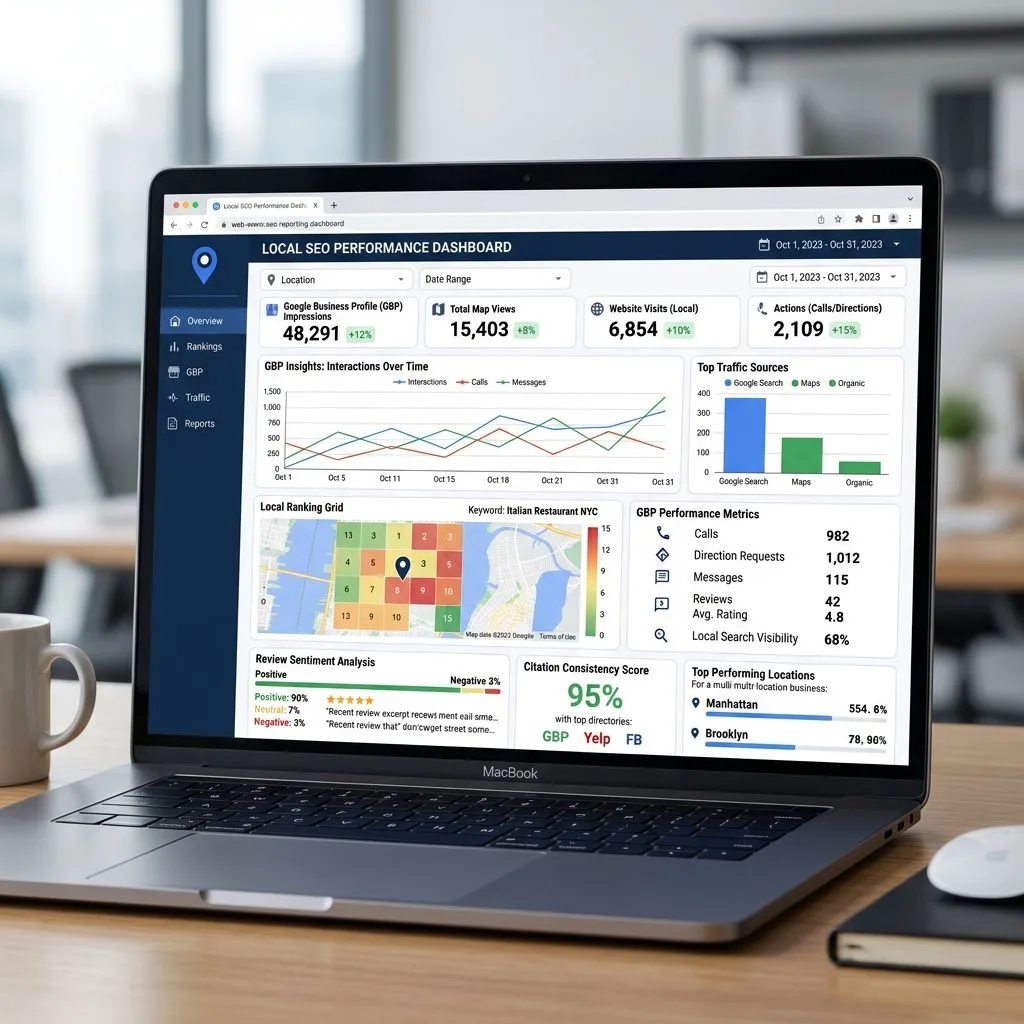
    A marketing professional reviews a branded SEO performance dashboard showing search visibility, organic traffic, clicks, and conversions on a laptop screen

    Core report data and metrics

    A useful white-label SEO report combines search visibility, traffic, engagement, business outcomes, technical health, and authority. I start with Google Search Console for queries, impressions, clicks, click-through rate, and landing-page performance, then use Google Analytics 4 alongside it for traffic sources, landing pages, user interactions, and conversions. Accuranker identifies these as core reporting inputs.

    Rankings belong in the report, but they are supporting evidence rather than the result itself. I connect ranking movement with clicks, organic visits, leads, conversions, or revenue trends, following the outcome-focused approach described by WhiteLabelSEO.ai. The same view can include organic conversions, bounce rate, branded and non-branded traffic, backlink gains and losses, page speed, and crawl issues when the connected data sources support them. Historical visibility and trend context matter as well; a current-period snapshot cannot show whether a change is temporary, sustained, or part of a longer movement.

    Metric groupExamplesReporting purpose
    Search visibilityKeyword rankings, impressions, CTRShows reach and search visibility over time
    Organic trafficOrganic visits, landing pages, channelsShows visits generated through search and where they arrive
    Business outcomesConversions, leads, revenue trendsConnects SEO activity to measurable business results
    Technical healthPage speed, crawl issuesIdentifies barriers to search performance
    AuthorityBacklink gains and lossesTracks changes in site credibility signals

    I keep engagement measures such as user interactions and bounce rate close to the traffic data, while conversions and revenue trends sit with the business results. That structure prevents a report from becoming an undifferentiated list of figures. For example, a ranking increase becomes meaningful when the related landing page also gains clicks, organic visits, and conversions; a crawl issue matters because it may restrict how search engines access that page. A report showing that chain gives the reader a concrete connection between visibility and business impact.

    Client-friendly report structure

    A client-friendly report starts with a short executive summary, not a wall of charts. I state what progressed, what blocked progress, and what should happen next in plain language so the client understands the month before reviewing the detail. A useful structure then moves from results to interpretation, priority issues or opportunities, recommended actions, and objectives for the next reporting period. That repeatable order gives every report a clear job and makes changes easier to discuss. Accuranker supports this sequence, while WhiteLabelSEO.ai emphasizes an outcome-focused summary. For related coverage, see SEO – rankspan.zenzen1.com.

    1. Start with the result. Summarize the reporting period’s meaningful movement, then identify the areas that need attention. Keep the language tied to the client’s goals rather than opening with definitions or unexplained abbreviations.
    2. Interpret the movement. Explain what changed, where it changed, and why it matters. For example, connect Search Console clicks, impressions, click-through rate, queries, and landing pages with the campaign activity that affected them. A rise in impressions without a corresponding improvement in clicks calls for a different response than broader gains across relevant pages. Accuranker describes this connection between performance data and campaign context.
    3. Rank the opportunities and problems. Each priority should identify the likely consequence and the action that addresses it. A weak page may call for content optimization, a crawl barrier for technical remediation, and a traffic increase without leads for follow-up conversion analysis. Google for Developers recommends connecting SEO work with measurable objectives and outcomes.
    4. Turn each KPI into a decision. Do not leave a chart to explain itself. Pair the metric with a short interpretation and a next action, such as reviewing a landing page, expanding a query theme, or checking a conversion path. This keeps the report useful for a client who does not work with search data every day. WhiteLabelSEO.ai recommends this interpretation-action pairing.
    5. Close with the next period’s objectives and add annotations where outside events clarify the movement. A known Google update or another material event can explain a sudden change in clicks, impressions, or rankings. Keep charts simple, define unfamiliar terms at first use, and remove metrics that do not support the client’s stated goals.

    The practical test is whether a client can move from a reported change to a reasonable decision without decoding raw charts. For instance, a landing page with more impressions but a weaker click-through rate should lead to a focused review of its search appearance and relevance, not another page of disconnected metrics.

    An SEO consultant presents a clear performance trend chart and prioritized recommendations to a client during a monthly review meeting

    Features that support agency workflows

    A reporting platform should let an agency control the client-facing experience from the first login to the final report. That can include the agency logo, color palette, branded domain or subdomain, client portal, reusable templates, email notifications, and removal of provider branding where the platform supports it. These controls matter because a report is part of the service experience, not just a container for exported data. MetricNexus describes white-label software in these terms, including branding across portals, templates, and notifications.

    The operational test is whether the workflow removes repeated assembly without hiding important judgment. Data collection should connect search, analytics, ranking, backlink, and technical sources instead of sending someone back to a spreadsheet for every reporting cycle. From there, recurring delivery, configurable sections, reusable templates, historical records, and PDF or web output can reduce formatting work. Accuranker describes the multi-source collection problem, while MetricNexus covers scheduled delivery, templates, history, and output options. I would still keep a person responsible for explanations, anomalies, strategy, and recommendations; automation can gather and format the evidence, but it should not make the judgment on its own. WhiteLabelSEO.ai makes that distinction explicit. For related coverage, see Notion content calendar.

    • Separate client access: each account should expose only its own reports and data, while agency users retain the broader operational view. MetricNexus identifies account separation as a core white-label requirement.
    • Access choices: check whether reports can use public or private links, whether login is required, whether connected accounts are read-only, and which visibility controls apply before adopting the workflow.
    • Historical context: retain earlier reporting periods and add annotations for known updates, launches, tracking changes, or other events so a movement can be interpreted rather than viewed in isolation.
    • Human review: require a final pass over explanations, strategy, anomalies, and recommendations even when collection, layout, and delivery are automated. WhiteLabelSEO.ai supports this division of work.

    Agency fit and buying questions

    I would start with the operating model, not the feature list. If the team already has dependable tools for rankings, audits, backlinks, and competitor research, a reporting layer may be enough. If those functions still need to be added, a broader SEO suite is the more practical comparison, as MetricNexus distinguishes between reporting software and a complete SEO toolkit. The difference becomes clear when an agency moves from a few accounts to several sites: account permissions, client separation, data connections, delivery schedules, exports, historical records, and human review all affect the work behind each client update.

    Buying priorityQuestions to askBest fit
    Reporting scopeDo we need dashboards only, or also audits, rankings, backlinks, and competitor research?A reporting layer for client visibility; a broader SEO suite when those SEO functions are also required.
    Client scaleHow many sites, users, and report projects must the workflow support, and can staff oversee them centrally without account switching?Multi-client dashboards and centralized oversight for agencies managing several sites.
    Brand controlWhich logos, colors, domains, templates, emails, and provider credits must be controlled across the client experience?A full white-label experience when the agency needs reports and delivery under its own identity.
    Data coverageWhich Search Console, analytics, ranking, and conversion metrics are required, and does the platform’s data match trusted sources?A platform that covers the required sources; verify alignment with Google Search Console before adoption.
    OperationsCan data collection, updates, approvals, and delivery run on a schedule, while a person reviews explanations and recommendations?Automated recurring reporting with human review, rather than a process built around repeated manual assembly.

    I would test the shortlist with a real client account before committing. Ask how quickly a new account can be configured, whether its data agrees with trusted sources such as Google Search Console, and how the platform defines success. OneLittleWeb identifies setup time, source checks, client scale, permissions, and use case as practical comparison points. I would also ask what result the reporting process is meant to measure and over what timeframe; Google for Developers recommends making success and expected results explicit rather than accepting broad performance language.

    For my own agency work, the useful dividing line is whether the system reduces coordination across sites without pretending to replace the SEO tools already in place. RankSpan is relevant to agencies seeking multi-site management, Search Console performance reporting, and branded client reporting. That makes it a fit for a team that needs centralized oversight and client-ready visibility, while claims should stay within those stated capabilities. A sensible trial is one existing client account: connect the account, confirm the Search Console view, configure the client’s access, and run one scheduled delivery before moving the rest of the roster.

  • Notion content calendar

    Notion content calendar

    A notion content calendar turns scattered ideas, deadlines, and channel plans into one working system. The useful version is more than a monthly grid: it should show what each item is, who owns it, what stage it has reached, and where the finished content will appear. I recommend starting with one central database, then adding views and templates as the publishing routine becomes clearer. That keeps the first setup manageable while leaving room for a rolling schedule across social and search content.

    Start on a blank Notion page and give the workspace a clear name, such as Content Operations. Create one central content database rather than separate lists for every channel. A database can hold the brief, production details, approvals, and publication record for each item. This follows the project-and-database approach described by Local Creative, while avoiding a structure that becomes difficult to maintain.

    Add the fields that support the next publishing cycle:

    Create several views from the same database. Use a calendar view for dates, a board view for status, and filtered views for upcoming work, drafts, review, approved items, scheduled posts, and published content. Keeping these views connected prevents the same content from being copied into multiple lists.

    Add a planning-period field that supports both a monthly content calendar and a rolling 30-day schedule. Reusable page templates can prefill recurring content types and include prompts for contributors who need help developing an idea. Start with only the fields required for the next cycle; a highly detailed workspace can make the system harder for beginners to use before the basic publishing habit is established. For related coverage, see What Is a Content Calendar and Why Teams Need One – rankspan.zenzen1.com.

    Notion content calendar database showing scheduled content items, publishing channels, statuses, owners, and dates in a calendar view

    Build the calendar database

    Start with a blank Notion page and give the workspace a clear name. Then create one central projects or content database rather than separate lists for Facebook, Instagram, or each other channel. This keeps planning in one place while still allowing different views for different publishing needs. A central database is also easier to expand later; the documented Notion setup uses projects and databases as the foundation for brainstorming, planning, and creating content across social channels (Local Creative).

    Use the title as the record name, then add a target publish date, planning period, channel, content type, status, owner, and priority. Give each item space for a brief, draft link, approval state, destination URL, and performance notes. Channel values can include Facebook, Instagram, TikTok, YouTube, Pinterest, and LinkedIn when those platforms are part of the publishing mix. Add a 30-day or monthly planning field as well, so the database supports a rolling schedule instead of locking you into one calendar month. A date-based calendar view shows timing; a board view groups records by status; filtered database views can show all content, upcoming work, drafts, items in review, approved items, scheduled posts, or published content.

    Create reusable page templates for recurring formats such as articles, videos, newsletters, or social posts. Each template can include a short prompt, briefing questions, and reminders about the information a contributor needs before starting. Keep the first version deliberately small. Begin with the fields required for the next publishing cycle, then add views, prompts, and extra properties after the basic calendar is being used consistently. For example, a small team might begin with one article template containing a title, monthly planning period, LinkedIn channel, publish date, brief, draft link, and approval state, then add performance notes once that item has been published.

    Content creator reviewing a multi-platform publishing plan on a laptop beside handwritten ideas and a monthly planning board

    Run content from idea to publication

    I treat each content item as a work order, not a parking place for ideas. Its status moves from idea to brief, draft, review, approval, scheduling, publication, and performance review, so the next action stays visible. One record can hold the brief, responsible person, deadline, approval state, final URL, and reporting notes in one handoff-ready space. That structure keeps context from being scattered across messages and documents, especially when several people touch the same piece. A database-based approach supports this combination of planning and execution (Local Creative). For related coverage, see How to Choose Target Keywords for Blog Content – rankspan.zenzen1.com.

    Solo creator workflow

    For a solo creator, I use one record per idea and move it from capture to publication without creating duplicate tracking. The brief is the decision point: for SEO work, I record the target keyword, search intent, related cluster, intended audience, and internal-link ideas before drafting. This supports the role of keyword research and content development described by Google for Developers.

    1. Capture the idea and assign its primary channel and target date.
    2. Write the brief, including the SEO fields when the item is search-focused.
    3. Create the asset, whether that is an article, image, video, or email.
    4. Mark the record ready for review after the asset is complete.
    5. Schedule the approved item for its assigned date.
    6. Add the published link as soon as the item goes live.
    7. Keep adaptations under the same parent record when one idea becomes a blog post, social update, video, or newsletter.

    I also set aside a weekly planning session to inspect the next 30 days. I fill genuine gaps, balance formats across channels, and move unfinished work to realistic dates instead of letting overdue records pile up. That habit keeps the calendar aligned with what I can actually produce, while the parent record preserves the relationship between one idea and every platform-specific version.

    Team and SEO workflow

    I make ownership visible before work begins. Each content item gets one owner and a status that names the next action: assigned, drafting, in review, approved, scheduled, or published. That removes the common team failure where several people assume someone else is moving the item forward. The status should describe work, not mood; “almost done” tells a collaborator very little.

    Approval is a required gate before scheduling. I have the reviewer check factual accuracy, brand fit, links, formatting, and search requirements, then record the decision on the content item. For search-led topics, the brief should connect the planned subject to keyword research and its wider content cluster. Google identifies keyword research and content development among common SEO services ( Google for Developers ). RankSpan can sit alongside Notion as an optional execution layer for clustering, rolling 30-day planning, article production, pre-publish checks, WordPress scheduling, and Search Console reporting, while Notion holds collaboration and edits. For related coverage, see How to Plan a Month of Content in One Sitting – rankspan.zenzen1.com.

    For an agency, I keep each client’s briefs and approvals in a separate database or workspace, then use one operating process to review deadlines, publication status, and results across accounts. That separation protects client context without losing management visibility. A practical review meeting might open with overdue approvals, confirm which approved items are scheduled, and finish by checking results from recently published work.

    Choose the right planning approach

    Notion is the strongest planning choice when I need one customizable workspace for documents, databases, project planning, and content organization. It can support brainstorming, editorial planning, and social publishing without forcing every team into the same structure, although that flexibility means someone must maintain the database as the system grows (Local Creative).

    I use a spreadsheet when the job is only to track topics, dates, and owners with very little workflow complexity. It keeps the planning surface light, but it is not the right place to assume broader publishing or reporting capabilities. An SEO automation platform fits work that continues past planning into keyword clustering, article production, quality checks, scheduled WordPress publishing, and search-performance reporting. A hybrid arrangement can be practical: Notion holds collaboration, briefs, and approvals, while RankSpan handles repeatable search and publishing operations. That division keeps editorial decisions visible without asking a planning workspace to perform every production task.

    ApproachBest fitWorkflow coverageMain consideration
    NotionFlexible editorial and social planningIdeas, briefs, owners, statusesFlexible structure requires ongoing database maintenance
    SpreadsheetSimple topic and deadline trackingBasic lists, dates, and assignmentsDetailed feature comparison is not established
    SEO automation platformSearch-led publishing programsKeyword clustering, article production, quality checks, scheduled WordPress publishing, and Search Console reportingBroader workflow scope than planning alone
  • Ai search optimization services

    Ai search optimization services

    AI search optimization services work best when they improve how a business is understood, retrieved, and supported by evidence. The task is not to force a page into a particular answer. It is to make the business, its offers, expertise, and important facts clear enough for answer systems to connect them with relevant questions.

    I would judge the work by the quality of the information architecture and the strength of the evidence around it. That means improving the site itself while also building credible references beyond it, with no promise of a fixed citation, ranking, or lead total.

    Answer systems combine information from several documents before producing a response. Clear entities and relationships therefore matter: a company should be identifiable, its services should be distinct, and each important claim should have enough context to stand on its own. InnoFeature Labs describes this approach as a move toward entity clarity, semantic context, and factual passages rather than isolated keyword repetition.

    I would put the most useful facts near the beginning of a page, answer specific questions directly, and add information that improves on the existing consensus. A service page, for example, should explain who the service is for, what problem it addresses, how it works, and what evidence supports the claims. That structure gives readers and retrieval systems fewer gaps to fill.

    Trust is broader than a technical markup format. PAN connects generative search visibility with contextual relevance, credible sources, real-world experience, authentic user-generated content, statistics where substantiated, and consistent editorial standards. E-E-A-T can guide editorial decisions, but it should not be described as a confirmed direct ranking factor.

    Technical access is the foundation, not the finished strategy. Robots.txt, firewall rules, server settings, structured data, and page accessibility should be reviewed so useful content is not blocked from relevant crawlers. A site should also maintain an active Bing Webmaster Tools account and address significant errors. Crawlable pages still need clear facts and useful context before they can contribute to a reliable answer.

    Laptop screen showing a conversational AI search response with several cited business webpages and a marketing team reviewing brand visibility

    How Visibility Is Built

    I build visibility for AI-enabled search by treating a page as a source that must be understood, not just a target for a phrase. These systems retrieve passages from multiple documents and combine them into conversational answers, so the content needs to identify the business, products, people, places, and services involved. It also needs enough context to explain how those entities relate, what makes the offering distinct, and which facts support the claims. This entity-led approach is central to how InnoFeature Labs describes optimization for systems such as ChatGPT Search and Gemini. For related coverage, see Keyword cupid.

    I put validated facts near the start of a page, then answer the specific question before expanding into supporting detail. A service page should not make a reader or an answer engine hunt for the basic explanation. It should state what the service does, who it serves, what problem it addresses, and what evidence supports its value. The next layer should add useful distinctions, examples, and relationships rather than repeat the same consensus language found elsewhere. InnoFeature Labs emphasizes factual passages, semantic context, and unique value for this reason.

    Trust comes from more than polished wording. Credible references, citations, substantiated statistics, first-hand experience, authentic user contributions, and consistent editorial standards give a page stronger support. PAN connects these practices with E-E-A-T, while also making clear that E-E-A-T is not confirmed as a direct ranking factor. Visibility can also be reinforced beyond a company’s own pages through paid, earned, shared, and owned media, because answer systems may draw from several types of sources. I also set expectations carefully: no provider can promise a particular AI citation, ranking, or lead volume. Retrieval and citation behavior changes over time. For example, a plumbing service page should open with the service area, emergency response scope, and licensing facts, then explain which problems it handles and cite the standard or manufacturer guidance behind its recommendations.

    Technical access and content structure

    Before changing content, I check whether search systems can reach and interpret the site at all. That technical audit covers robots.txt, firewall rules, server settings, structured data, page accessibility, and whether useful content is available to relevant crawlers such as OAI-SearchBot and ChatGPT-User. I also verify that Bing Webmaster Tools is active and free of significant errors, since some AI search experiences use discovery systems connected to Bing. These checks are outlined by InnoFeature Labs.

    • Review security and server controls that could block legitimate crawlers or prevent pages from loading reliably.
    • Inspect structured data and page accessibility so important business information has a clear technical representation.
    • Confirm that Bing Webmaster Tools reports a clean enough site profile for ongoing discovery and troubleshooting.

    Access is only the entry point. A crawlable page still needs clearly defined entities, reliable facts, useful context, and supporting evidence before an answer system can use it confidently. A technically open site with vague or unsupported information remains difficult to interpret, so I treat crawlability and content quality as connected parts of the same review.

    Measurement and ongoing improvement

    I measure progress in two layers: conventional search performance and visibility inside answer engines. Search Console can show indexed pages, organic impressions, clicks, query coverage, referral traffic, and conversions. It cannot, by itself, explain whether an AI system mentions a brand, cites a particular URL, or answers a new question because of recent work. That requires a repeatable prompt-monitoring process across the answer engines relevant to the audience.

    • Indexed pages and organic impressions
    • Clicks, query coverage, referral traffic, and conversions
    • Brand mentions and cited URLs in monitored answers
    • Changes in the questions a business appears to answer

    I turn those observations into an operating cycle rather than a stack of isolated articles: research is grouped into related topics, topics feed a rolling publishing calendar, editors review each piece, publication is scheduled, and results are reported at regular intervals. A provider should state the metrics, reporting schedule, realistic outcomes, and response when content or technical changes fail to improve visibility. Google for Developers recommends asking SEO providers how they measure success, what results and timeframes to expect, and how their experience fits the business. That standard makes a report useful: it connects a documented change to the search behavior it was meant to influence. For related coverage, see How to Choose an SEO Company in NEPA.

    SEO specialist reviewing robots.txt access, structured data warnings, crawler activity, and search performance metrics on a desktop monitor

    Service Models and Cost Considerations

    When I review a small local site, the first buying question is not the label on the service. It is whether someone has time to handle research, publishing, review, and reporting, and whether the work covers one site or several. An internal team may manage foundational work when the site is small and the marketing workload is manageable. A specialist becomes more useful when the business needs both direction and hands-on execution.

    Service modelTypical fitWhat to expectMain limitation
    DIY or internal teamSmall site with available marketing timeBasic planning and implementation handled internallyLimited capacity when publishing volume or technical complexity grows
    Specialist consultant or agencyBusiness needing strategy and hands-on expertiseAdvice, content development, technical guidance, and execution can be combinedScope and reporting practices vary
    Managed workflow with software supportAgencies or teams managing recurring content operationsSoftware can reduce repetitive research, production, quality-control, publishing, and reporting work; human review remains necessaryAutomation does not replace factual review, brand judgment, or compliance checks
    Enterprise programComplex brands, multiple markets, or many propertiesCoordinated work across sites, markets, publishing needs, and technical requirementsNot published

    A local-service buyer should read the commercial details as carefully as the service description. Pleiades Consultancy publishes monthly retainer tiers for single-location, multi-location, and enterprise specialty businesses, along with possible setup fees. Those figures are that provider’s claims, not a market standard. I would check whether a proposal separates contracts, per-location charges, directory work, structured data, content scope, and tool markups before comparing offers.

    For an agency managing recurring work, the operational difference is visible in the handoffs. A workflow can organize research, production, checks, scheduled publication, and reports, but a person still needs to confirm facts, protect the client’s judgment, and approve material before it goes live. In practice, the useful question is whether the model can handle the workload without turning review into an afterthought. For example, a multi-site team may need one repeatable process for content tasks while retaining human approval for every client-facing page.

    How to Choose a Provider

    I choose a provider by testing its process before approving a long engagement. I ask for relevant prior work, success stories, realistic timeframes, measurement methods, and experience with the intended industry and geography. Google for Developers recommends the same kind of diligence. The first engagement should usually be a documented audit and prioritized action plan, not an open-ended commitment.

    1. Require a plain explanation of proposed site changes, outside sources or mentions the provider will pursue, content approval responsibilities, and the access it needs. A useful plan names the technical blockers, content gaps, authority opportunities, baseline measurements, owners, and review dates.
    2. Separate conventional search reporting from observations of answer-engine visibility. Otherwise, a traffic increase may be presented as proof of an AI citation when it is only an ordinary search result.
    3. Reject promises of permanent rankings, guaranteed citations, instant traffic, or fixed lead volumes. I want to see stated assumptions, controlled tests, and a clear explanation of what may change.
    4. If the provider serves agencies, check whether its workflow handles multiple client sites, separate site administration, client-ready reporting, content calendars, publishing approvals, and quality checks. RankSpan is a practical example of the kind of centralized operating layer an agency may need.
    5. Match the level of help to the situation. A small local business can handle much of the foundation work internally, while professional support becomes more useful during a redesign, launch, or expansion into a complex market.

    For example, I would approve a pilot only when the provider can show who will change each page, who signs off, how results will be recorded, and when the work will be reviewed. Choose an internal workflow if the site is simple and someone can own those tasks; choose a specialist if coordination, governance, or market complexity is the real constraint.

  • Keyword cupid

    Keyword cupid

    Keyword Cupid addresses a practical SEO problem: a large keyword list does not tell me which terms belong on one page and which deserve separate URLs. I use clustering to turn that list into page decisions, not just tidy categories. The key question is whether Google returns similar pages for the queries. Keyword Cupid applies that SERP evidence to group related terms, then turns the results into planning outputs such as clusters, page assignments, and topical structures.

    The workflow begins with a keyword export from a research platform or Search Console. The list may come from Ahrefs, Semrush, Google Keyword Planner, Moz, or Google Search Console. Keyword Cupid then analyzes Google results for the submitted queries and compares the URLs appearing for each one. This makes the ranking pages—not just the wording of the keywords—the central signal. ( Dango )

    The updated pipeline is described as using live Google SERP data, unsupervised machine-learning models, finer cluster granularity, and higher throughput for larger datasets. A single report is also described as processing thousands of keywords in one batch. That makes the tool relevant after keyword discovery and before content briefs, particularly when manual sorting would slow page planning. The reported SERP Spy module adds on-page statistics for ranking pages within a cluster, including average content length in the upgraded version. ( Yahoo Finance )

    The practical safeguard is manual review. Google results change, and overlap can be partial or ambiguous. I would inspect borderline groups, compare them with existing URLs, and record why a group should share one page or receive separate pages. That step keeps the report tied to an actual publishing plan instead of treating an automated grouping as the final decision.

    A spreadsheet of varied SEO keywords divided into clearly labeled intent-based groups for content planning

    How SERP clustering works

    SERP clustering starts with a keyword file, not with a page outline. I would export the list from a research platform such as Ahrefs, Semrush, Google Keyword Planner, Moz, or Google Search Console, then submit those queries for analysis. The workflow examines the Google results for each term and compares the URLs appearing in those results. When several queries return many of the same ranking pages, the system treats that overlap as evidence that the searches have related intent and places them in one group. That makes the cluster reflect observed search behavior rather than just similar wording. (Dango; Yahoo Finance)

    1. Import the keyword list and let the system retrieve or analyze the relevant Google SERPs. The updated pipeline is described as using live Google data, unsupervised machine-learning models, finer cluster granularity, and greater throughput for larger datasets. Those changes are intended to make the groups more detailed and practical when the submitted list contains many related queries. (Yahoo Finance)
    2. Compare the ranking URLs across queries. A term that shares many result pages with another term is placed closer to it than a term with a substantially different result set. The resulting structure can show broad themes and narrower subgroups instead of producing one flat list of similar phrases. (Dango)
    3. Review the resulting outputs. Reported formats include an interactive hierarchical mind map and a downloadable Excel file containing cluster assignments, aggregated search volume, keyword difficulty, and CPC data. The report can also form a topical-silo structure, connecting keyword groups to pages and pages to silos. (Yahoo Finance)
    4. Use SERP Spy to inspect the pages already ranking inside a cluster. The upgraded version is described as providing on-page statistics for top-ranking pages, including average content length, so the cluster is accompanied by some page-level context rather than a keyword grouping alone. (Yahoo Finance)

    The useful distinction is between a shared topic and a shared result set. Two queries may contain the same subject words but produce different pages in Google; the clustering signal separates those cases by looking at ranking-URL overlap. Conversely, different wording can still place together when the same pages consistently rank for both terms. For example, a list containing “best project management software” and “top project management tools” may show up as one related group if their result pages substantially overlap. The mind map can then expose that relationship, while the spreadsheet records the assigned group and its supporting metrics. That gives me a concrete trail from imported keyword file to SERP evidence to an organized cluster.

    Inputs and report outputs

    Keyword Cupid belongs between keyword discovery and content briefing. I would bring in a researched list, review the resulting groups, then use the report to decide which pages and topical silos need planning. That makes it a planning step rather than a replacement for research: the value comes from turning an unstructured set of queries into an organized content map. The workflow described by Dango places the tool in this handoff between research and production.

    • For a normal project, the practical sequence is researched keyword list, generated groups, human review, then page and silo planning before briefs are written.
    • For larger projects, Yahoo Finance describes a single report processing thousands of keywords in one batch. That indicates a fit for substantial exports, but it does not set a maximum list size, processing time, or service-level benchmark.

    Intent and page decisions

    Shared wording is a clue, not a page assignment. Two queries can contain nearly the same terms yet deserve different URLs if the pages ranking for them show limited overlap. I would therefore compare the ranking-page overlap before deciding whether one article should cover both queries (Dango). The result set matters more than how similar the phrases look in a spreadsheet.

    Partial overlap needs closer inspection. Related queries may share several ranking pages while still showing different intent, and finer separation can prevent one broad cluster from hiding that distinction (Yahoo Finance). I treat the cluster as evidence of current search behavior, not as an automatic publishing instruction. Results change, and the final page decision still needs an editorial check against the page’s purpose and the experience it should provide (Dango).

    1. Compare how much the ranking URLs overlap, rather than counting shared words alone.
    2. Flag groups with partial overlap for a separate intent review instead of accepting one broad cluster immediately.
    3. Ask whether one page could answer every query clearly, or whether combining them would blur the reader’s purpose.
    4. Record the reason for combining or separating the terms before turning the decision into a brief or URL plan.

    Keyword Cupid evaluation criteria

    Suppose I inherit a large export containing close variants, comparison terms, and queries with local or transactional modifiers. My first test is not whether the phrases look related. I check whether the grouping signal uses overlap among ranking URLs, because that reflects the pages Google currently returns. A method built mainly on shared words, n-grams, topic labels, NLP entities, TF-IDF, or autosuggest can produce tidy groups while missing a change in intent. That distinction matters when the next decision is whether one page should serve the whole group. I would also inspect borderline clusters rather than judging the tool from an easy set of near-duplicates. A credible evaluation asks how the system handles terms that share a subject but produce materially different results. Dango describes this SERP-based approach, but I would treat it as a method to test, not as proof of perfect grouping.

    Next, I would run the output against the team’s actual planning workload. An agency handling substantial imports needs to know whether batch processing remains manageable, whether the Excel export can move cleanly into its existing process, and whether the interactive mind map helps people inspect relationships rather than merely decorate a report. I would check that search volume, difficulty, and CPC fields remain useful after grouping, that topical-silo views translate into a workable site structure, and that page-level SERP analysis answers practical briefing questions. Those checks are different from asking whether a feature exists. The real question is whether a strategist can move from an assigned group to a defensible URL decision without rebuilding the analysis in another spreadsheet. I would also look for partial-overlap groups: if two sets share some results but differ in intent, broad merging can hide the need for separate page experiences. Finer separation is valuable only when it survives that hands-on inspection.

    I would record each cluster’s decision beside the evidence used to make it, then revisit the result before publication. Google results are time-sensitive, so a group that looked coherent during the export may shift as ranking pages change. Dango supports treating the result as current evidence rather than a permanent rule. I would compare each proposed group with existing URLs, the business goal, and the experience the intended page must provide. For some projects, a Search Console-led process may fit better than starting with third-party volume research, particularly when first-party query and page data should drive the planning conversation. That choice should be made before importing a large file, not after an elaborate report has been built. In practice, my evaluation record would show the input source, the grouping signal, the borderline cases I reopened, and the final page rationale; that is a stronger accuracy test than a blanket percentage claim.

    Method and cluster quality

    SERP overlap is the stronger quality signal because it shows how Google currently responds to a query. Text similarity can connect phrases that look alike while returning very different result sets, so a cluster built from wording alone may conceal a real difference in what searchers expect. For related coverage, see How to Choose an SEO Company in NEPA.

    I test cluster quality at the edges, not just in the obvious groups. Borderline terms often share a subject but differ in purpose: a comparison query may seek alternatives, an informational query may seek an explanation, a transactional query may signal readiness to buy, and a local query may require location-specific results. Those distinctions are where a broad cluster is most likely to become misleading.

    A practical check is to take a mixed group and inspect whether the result patterns remain consistent across its terms. For example, “best project management software” and “project management software pricing” may concern the same product category, but their result sets can reflect comparison and purchase-focused needs. That pair deserves closer review than two near-identical wording variants.

    Workflow fit and evidence

    Keyword Cupid fits a planning workflow that begins with a substantial keyword export and ends with decisions about content coverage. I would not treat it as the first stop when the real problem is finding new query ideas. Its useful role is narrowing an existing research set into workable content assignments, so the test is whether the resulting organization saves review time without replacing editorial judgment. Before committing to any SEO tool, I would also compare its recommendations with Google for Developers and define how each proposed change will be assessed.

    • Verify current product information for pricing and stated limitations before buying. Product terms, included features, and constraints can change, so an older review should not serve as the final commercial reference. Dango
    • Ask what a recommendation is expected to improve and which measurement will be used to assess it. A clear evaluation plan is more useful than accepting an unexplained score or automated suggestion.
    • Treat any promise of a first-place Google ranking as a warning sign. Google advises that no provider can guarantee a top result, making confidence in the sales claim itself part of the buying review. Google for Developers

    Keyword clustering approaches compared

    The approaches differ mainly by the signal used to decide whether terms belong together. SERP-based clustering compares the URLs ranking in Google and uses overlap as evidence of related search intent, while text-based methods may group phrases through shared wording, n-grams, topic tags, entity extraction, TF-IDF, semantic similarity, or autosuggest data. I would treat those as different kinds of evidence, not interchangeable names for the same operation. Dango describes Keyword Cupid’s approach as organizing queries from observed ranking behavior rather than surface similarity. Manual spreadsheet work remains reasonable when the list is small enough for a person to inspect every term and decide which URLs should exist.

    I also separate the source of the keyword data from the method used to organize it. Ahrefs, Semrush, Google Keyword Planner, Moz, and Search Console can supply keyword data; clustering then turns that data into page-level decisions. A Search Console-led process starts from first-party queries, impressions, clicks, and related performance data, which may suit a team that values its own site evidence over a workflow beginning with third-party keyword-volume research. That distinction matters when reviewing a tool: the input source answers where the terms came from, while the clustering signal answers why they were grouped. Dango identifies both keyword-platform exports and Search Console-led work as relevant workflow choices.

    ApproachPrimary signalBest fitMain review need
    SERP-based clusteringRanking-URL overlap in Google resultsLarge keyword exports and page-planning workReview whether the resulting groups fit intended page decisions
    Text-based or semantic groupingShared wording, entities, similarity, TF-IDF, n-grams, topic tags, or autosuggest dataVariesNot published
    Manual spreadsheet groupingHuman review of terms, existing URLs, and planned URLsSmall keyword listsInspect each term and decide which URLs should exist
    Search Console-led clusteringFirst-party queries, impressions, clicks, and related performance dataTeams prioritizing first-party performance data over third-party keyword-volume researchVaries
    A visual workflow showing keyword clusters moving through page mapping, content briefing, quality review, and scheduled WordPress publishing

    Practical workflow after clustering

    I begin by treating the keyword file as raw material, not as a publishing plan. Before running Keyword Cupid, I remove obvious duplicates, discard terms unrelated to the audience or service scope, and flag wording that belongs to a different business problem. This cleanup prevents weak inputs from producing convincing-looking groups. The goal is a file that reflects the site’s actual territory, as recommended in Dango, rather than every phrase collected during research.

    1. Run the clustering process, then open the groups that show only partial agreement among ranking pages or appear to combine different stages of the search journey. I look for the point where one group stops describing one useful page and starts asking the reader to do something else.
    2. Give each accepted group a destination: an existing URL, a planned URL, or no new page because the site already covers that intent. This page-mapping step turns a cluster into an editorial decision; Rankspan describes the same connection between target keywords and content planning.
    3. Check for cannibalization before anyone drafts. Two URLs aimed at the same intent can compete for attention, while forcing distinct intents onto one URL can leave part of the demand poorly served. I record the reason for keeping terms together or separating them instead of relying on similar wording alone, consistent with the cautions in Dango.
    4. Convert the approved group into a brief. I include one primary topic, supporting queries, the page’s purpose, internal-link targets, and a plain explanation of why the terms belong together or need separate treatment.
    5. Keep a decision trail beside the brief: the original keyword file, cluster assignment, SERP evidence, target URL, reviewer decision, and later performance measurement. That record makes it possible to revisit a questionable grouping when results or page needs change. I treat the automated output as an input to review, not as proof that a page will rank; Google for Developers recommends defining how SEO changes will be evaluated.

    For example, a group with one clear destination can move directly into briefing, while a borderline group should carry a short review note before writing begins. That note might say that the terms share some ranking pages but differ in the reader’s next action, so the site will use separate URLs. The practical finish is not the exported cluster file; it is a traceable page decision that a writer, editor, and analyst can all inspect later.

    Mixed keyword list example

    I would use a deliberately mixed test list rather than a set of near-duplicates. The original file could contain “best project management software,” “top project management tools,” “how to choose project management software,” and “project management software pricing.” The point is to record the original terms, the resulting groups, the target URL, and the reason for combining or separating them, as recommended in Dango.

    The first two terms form a close comparison group only if their ranking URLs substantially overlap. The question about choosing software may require a separate informational page if Google returns a different content type or purpose. A pricing query also deserves its own review rather than being merged because the wording shares the same product topic. If an existing guide already covers one variant’s intent, the mapping record should improve or update that URL instead of automatically creating another page.

    Keyword patternLikely review questionPage decision
    Close comparison variantsDo the ranking URLs substantially overlap?Consider one page when the ranking URLs overlap; separate the terms when they do not.
    Distinct informational queryDoes Google show a different content type or purpose?Consider a separate URL when the result type or search purpose differs.
    Existing-page variantIs the intent already covered by a current URL?Improve the current URL when it already covers the intent; otherwise map the term to a planned page.

    A useful worksheet therefore keeps the list visible beside each group and decision. For example, the two comparison terms can remain together pending URL review, while “how to choose project management software” is marked for separate consideration because it may serve an informational purpose. No traffic, ranking, or conversion result belongs in this example; the useful output is the documented reason for each page assignment.

    Agency operations and validation

    A useful SEO recommendation states what should change, what result would indicate success, and how that result will be measured. I write each recommendation as a testable instruction rather than a promise: publish a page, improve its coverage, or adjust its internal links, then define the relevant observation period and reporting source. At RankSpan, I would want that record attached to the task before anything reaches production. Google for Developers also advises asking how proposed SEO changes will be evaluated and treating guaranteed first-place rankings as a warning sign. Google for Developers offers the right standard: explain the work and its evaluation.

    • Expected result: the selected page better matches the intended query. Measurement method: compare impressions, clicks, and query coverage in Search Console after the page has had time to collect data.
    • Expected result: related terms are handled without creating unnecessary competing URLs. Measurement method: review the affected pages, their target queries, and subsequent impressions and clicks for signs of overlap or missed coverage.
    • Expected result: each published change has an accountable review trail. Measurement method: record the recommendation, target URL, implementation date, reviewer, and the performance check used to assess it.
  • How to Choose an SEO Company in NEPA

    How to Choose an SEO Company in NEPA

    How to choose an SEO company in NEPA starts with defining what the work must accomplish. A provider cannot build a useful plan around “better rankings” alone; the target may be qualified visitors, phone calls, leads, store visits, or sales. I would settle that question before comparing agencies, specialists, or consultants. It gives every proposal a clear test: does the recommended work connect to the business result you actually need?

    I would also decide how much execution belongs outside the company. Some businesses need technical changes, content, and local search work handled end to end. Others have staff who can implement recommendations and need focused research or direction. That distinction affects the right partner and prevents paying for services your team can already manage.

    For local businesses, relevant experience should be specific. Ask for examples that identify the client’s industry and location, the work performed, the objective, and the result measured. Google recommends asking SEO providers about experience related to your industry and city, along with the methods they use and the results they expect. Google for Developers General experience across Pennsylvania is not the same as understanding how customers search for a particular service in Northeastern Pennsylvania.

    Write these requirements down before taking sales calls. A short brief might say that the goal is more qualified service inquiries in selected NEPA communities, while the internal team will handle website approvals. That single document gives candidates the same starting point and makes vague proposals easier to identify.

    Set your NEPA SEO goals first

    Before I speak with an SEO provider, I define the business result I want. That might be more qualified website visitors, phone calls, inquiries, store visits, or sales. A goal gives the conversation a useful direction and makes it easier to judge whether a proposed service addresses a real business need. LeaseMyMarketing

    I then narrow the type of help required. Some businesses need stronger visibility in nearby searches. Others need technical improvements, better content, website work, or support across several digital channels. Google recommends asking prospective providers about their experience, methods, expected results, and familiarity with the relevant industry and city. That makes a provider’s background more useful when it matches the market and work involved, rather than simply sounding broad. Google for Developers If the business operates in healthcare, manufacturing, or technology, I would ask for examples from a similar field instead of treating general Pennsylvania experience as enough. The example should identify the client, location, objective, work completed, and measurable outcome. Astoundz

    Finally, I separate work my team can handle from work that requires outside execution. If I can manage content or basic website changes internally, a focused specialist or limited consulting engagement may fit. If the team needs broader implementation, a full-service agency may be more appropriate. The useful question is not which provider offers the longest service list, but where outside help will remove a genuine operational gap. Leacon Digital For example, a NEPA manufacturer seeking qualified inquiries might need local visibility and technical website work, while keeping routine updates in-house. For related coverage, see How to Choose Target Keywords for Blog Content – rankspan.zenzen1.com.

    A Northeastern Pennsylvania business owner reviews a website, local search results, and lead goals with an SEO consultant at a desk

    Check the proposed SEO strategy

    The proposed strategy should show how the provider will turn local search evidence into specific work on your site and listings. I would ask for a sample keyword-research deliverable before approving a plan, not just a list of broad phrases. It should reveal the search intent behind each term, its connection to your services, the locations being targeted across NEPA, and the page or content topic intended to address it. That document gives me a practical way to judge whether the strategy reflects how nearby customers actually search. Google for Developers

    • Ask which competitors and websites will be examined. The analysis should consider their authority, rankings, content depth, number of competing sites, and coverage of the services you offer. A provider that cannot explain the comparison set may be working from a generic template. Genesis Wtech
    • Check that the local plan covers the full Google Business Profile, including categories, hours, photos, descriptions, and reviews, alongside local listings, website improvements, technical SEO, content, and continuing analysis. These elements should work together rather than appear as isolated tasks. LeaseMyMarketing
    • Ask how profile and listing activity will support website visibility and how the provider will observe resulting calls, visits, leads, or sales. The answer should describe the connection between each activity and the customer action it is meant to influence. LeaseMyMarketing
    • Confirm that the methods follow Google Search Essentials and ask the provider to explain them in plain English. Have it identify tactics it will avoid, including shortcuts it considers unsafe or manipulative. Google for Developers
    • If automation is part of publishing, ask who reviews the material, checks facts, approves it, performs pre-publication checks, and monitors quality afterward. A visible control process matters more than the word automated. Rankspan
    • Favor a workflow that keeps researching keywords, planning content, improving technical elements, and analyzing performance. Search optimization is ongoing work; a plan built around one-time edits or shortcuts has little room to respond when the market or search results change. Softbenz

    Compare evidence, reporting, and partner fit

    The partner type should match the work your team can actually carry. A full-service agency is suited to SEO alongside web, paid, social, or reputation work. An SEO specialist keeps the scope centered on search strategy and execution. An individual consultant can be a practical fit when internal staff can implement recommendations. I would compare those boundaries before comparing presentations, using the same questions about search depth, related marketing support, technical work, content execution, communication, and reporting. Leacon Digital

    Partner typeBest fitQuestions to ask
    Full-service agencyBusinesses needing SEO plus web, paid, social, or reputation supportWhich services are included, who manages each part, and how will the related work connect? How often will reports arrive, and who explains them?
    SEO specialistBusinesses needing focused search strategy and executionHow deep is the search expertise? What technical, content, and reporting work is included, and how will progress connect to business activity?
    Individual consultantBusinesses with internal staff who can implement recommendationsWhich recommendations will you deliver, what must our team implement, and how will you review progress?

    Treat portfolios and case studies as working evidence, not decoration. I look for the client situation, work performed, timeline, measurement method, and outcomes such as calls, leads, customers, visibility, or qualified traffic. Reviews can reveal patterns in communication, transparency, realistic expectations, and delivered results, but I would still request direct references and verifiable work. Then I would score every candidate against the same criteria: NEPA or relevant geographic experience, industry experience, customization, technical ability, content execution, communication, and reporting clarity. Google for Developers and Softbenz A recurring report should bring together relevant rankings, qualified organic traffic, leads, conversions, Search Console data, and local visibility across the website, Google Business Profile, and local listings. Rankings are useful indicators, not guaranteed outcomes, so the provider should explain how search performance connects to actual business activity. Ask who manages the account, when reports arrive, who interprets them, and how quickly questions receive an answer. A candidate that cannot make those reporting responsibilities concrete has not finished defining the partnership.

    A laptop displays a clear SEO report with Search Console data, local rankings, organic traffic, phone calls, and lead conversions

    Review pricing, contracts, and warning signs

    Read the proposal as an operating agreement, not a sales summary. Compare what each provider will actually do, what falls outside the engagement, how often progress is documented, and which business outcomes the work is meant to support. A clear scope makes competing proposals easier to compare than a prominent starting figure or a broad promise of growth. proposal guidance SEO also needs time to produce meaningful evidence; one guide recommends allowing a six-month commitment, so ask for milestones that match the work rather than promises of immediate change. contract guidance

    • List the work included before signing: an audit, keyword research, technical recommendations, content, website changes, Google Business Profile and local-listing work, analysis, and recurring reports. State which tasks require your approval or implementation. Google for Developers
    • Identify who owns and controls the website, CMS, analytics, Search Console, business profiles, reports, and content produced during the engagement. Administrator access should not depend on one person’s account or a verbal promise. contract guidance
    • Write down cancellation notice, final deliverables, access handover, reporting access, and transition responsibilities. The agreement should explain what happens to unfinished work and account permissions when the relationship ends. contract guidance
    • Confirm the primary goals, the provider’s scope, the fit with your available resources, relevant references, reporting schedule, implementation responsibilities, compliant methods, and the measures that will define progress. Google for Developers

    I treat guaranteed rankings, guaranteed success, overnight results, quick fixes, vague growth claims, unexplained tactics, and unclear contract language as reasons to pause. A credible provider can explain what it controls, what may affect timing, and how its work will be evaluated without turning uncertainty into a promise. warning-sign guidance Before signing with RankSpan, I would apply the same test: the written agreement should tie its publishing, analysis, and reporting responsibilities to specific deliverables, access rules, and handover steps. The practical test is simple: if a proposal does not tell you what arrives, who can change it, and what you retain, it is not ready to sign.

    A business owner compares two SEO proposals beside a checklist covering deliverables, timelines, reporting, access, and contract terms